Building an online store that sells customizable printed products (t-shirts, hoodies, mugs, gifts) across multiple countries is one of the most demanding challenges in eCommerce. The shopper doesn't just buy a product; they build one. They pick a garment, choose a color and size, upload their own artwork or select a ready-made design, and expect a live preview. All of this needs to happen in their own language, in their own currency, with shipping rules that make sense for their local market.
Pulling this off requires four distinct technologies working together: Magento 2 as the backend, the Hyvä theme as the frontend, Magento's native multi-store architecture for internationalization, and an API-integrated product customizer for the printing experience.
Let's look at what each piece does and why this particular combination works so well.
1. Magento 2: The Backend Built for Complexity
Magento 2 (Adobe Commerce / Magento Open Source) remains the platform of choice when a business outgrows simple storefronts. Its true strength lies in handling complexity natively, managing logic that other platforms need a pile of third-party apps to approximate.
For a print-on-demand business, the backend features that matter most include:
- Deeply Configurable Products: Every garment exists in dozens of color and size combinations, each potentially with its own stock levels and imagery.
- Tiered Pricing: Volume discounts kick in automatically. For example, a store can automatically apply a 5% discount at seven pieces, 45% off at a hundred, and 50% off at one hundred and fifty pieces. This allows the same store to serve an individual buying one shirt and a company ordering for a whole team without requiring a separate B2B quoting process.
- Flexible Catalog Attributes: The system easily organizes products by brand, fabric, sustainability certification, and print compatibility.
- Open Ecosystem: Magento is self-hosted and open source. The merchant owns the customer data, the catalog, and the customization without being locked inside a SaaS vendor's walled garden.
2. Hyvä: Fixing Magento's Biggest Weakness
For years, Magento's Achilles heel was its default frontend, Luma. Luma is built on a heavy stack of RequireJS, Knockout.js, and layered XML layouts. The result is often a slow first paint, poor Core Web Vitals, and a sluggish feel. This is deadly for a store where shoppers browse image-heavy catalogs and interact constantly with product options.
The Hyvä theme solves this by throwing the legacy frontend away entirely and rebuilding it on two lightweight modern tools:
- Tailwind CSS: A utility-first CSS framework that generates only the styles actually used, producing a tiny CSS payload.
- Alpine.js: A minimal JavaScript framework that handles interactivity directly in the markup without a render-blocking JavaScript pipeline.
The critical point is what Hyvä doesn't change. All of Magento's backend logic (catalog, pricing, promotions, checkout, multi-store) stays exactly as it is. Only the presentation layer is replaced. A typical Hyvä storefront loads an order of magnitude less JavaScript than Luma, passes Core Web Vitals comfortably, and feels instant even on mobile connections.
For interaction-heavy stores, this is not a vanity metric. A customer who is about to spend ten minutes designing a shirt will abandon a frontend that stutters. Speed is what keeps them in the flow long enough to actually customize a product.
3. Multi-Store, Multi-Domain, Multi-Currency
Magento 2's most underrated capability is its native hierarchy of website > store > store view. From a single installation and a single admin panel, a merchant can run highly localized operations:
- Localized Domains: Running separate domains per country (a .de domain for Germany, .it for Italy, .nl for the Netherlands). These are real localized websites, not translated subfolders.
- Localized Store Views: Each domain serves its own language, translated product content, and localized URL slugs, which is far superior for local SEO than reusing English URLs.
- Native Multi-Currency: Each store view has its own display currency. A euro-zone customer sees €, while a Czech customer sees prices in koruna (CZK), creating zero checkout friction.
- Localized Commerce Rules: Shipping carriers, free-shipping thresholds, tax displays, and payment methods are configured per store.
The operational payoff is enormous. The catalog is maintained once, and orders from every country land in one order grid. Entering a new market means adding a store view and a domain, rather than building, hosting, and syncing an entirely separate website.
4. The Product Customizer: Where Print-on-Demand Lives or Dies
The design tool is the heart of a custom-printing store, and the smart architectural decision is almost always to buy and integrate, not build.
Specialist customizer platforms (like ShirtPlatform) provide a browser-based designer where customers upload photos, add text with font libraries, and apply effects with a live preview on the actual garment.
The integration pattern that works best is a clean REST API connection. The customizer plugs into the Magento product page and pulls its data from the platform's API. Done well, the shopper never feels the seam. They move from the Magento product page into the designer and back to the Magento cart as if it were all one system.
This platform typically handles the production side too, routing the finished design straight to the print facility while supporting the four main garment-printing technologies:
- DTG (Direct-to-Garment): Ideal for photographic prints on cotton.
- DTF (Direct-to-Film): Durable multi-color prints on many fabrics.
- Flex/Flock: Cut foil for bold lettering and numbers.
- Sublimation: All-over prints on polyester.
The division of labor is the ultimate architecture lesson here. Magento owns the catalog, pricing, customers, and checkout. The specialist platform owns the pixel-level design experience and the print pipeline. A REST API stitches them together, ensuring neither system is forced to do a job it's bad at.
5. Supporting Cast: Images and Performance at Scale
A garment catalog multiplies fast. Hundreds of products times a dozen colorways each equals thousands of heavy images. Keeping a Hyvä storefront fast requires a disciplined image pipeline: server-side cached and resized product renders per colorway, next-gen formats like WebP, responsive image sizes per device, and lazy-loading below the fold. Without this, image weight quietly eats every millisecond the theme saved.
A Real-World Example: Shirt Tuning
If you want to see this entire stack running perfectly in production, look at Shirt Tuning. They are a European custom-apparel brand operating six country storefronts from what is clearly a single Magento 2 backend:
- shirttuning.nl (Dutch)
- shirttuning.de and shirttuning.at (German)
- shirttuning.it (Italian)
- shirttuning.sk (Slovak)
- shirttuning.cz (Czech, priced in koruna while the others use euros, showcasing multi-currency in action)
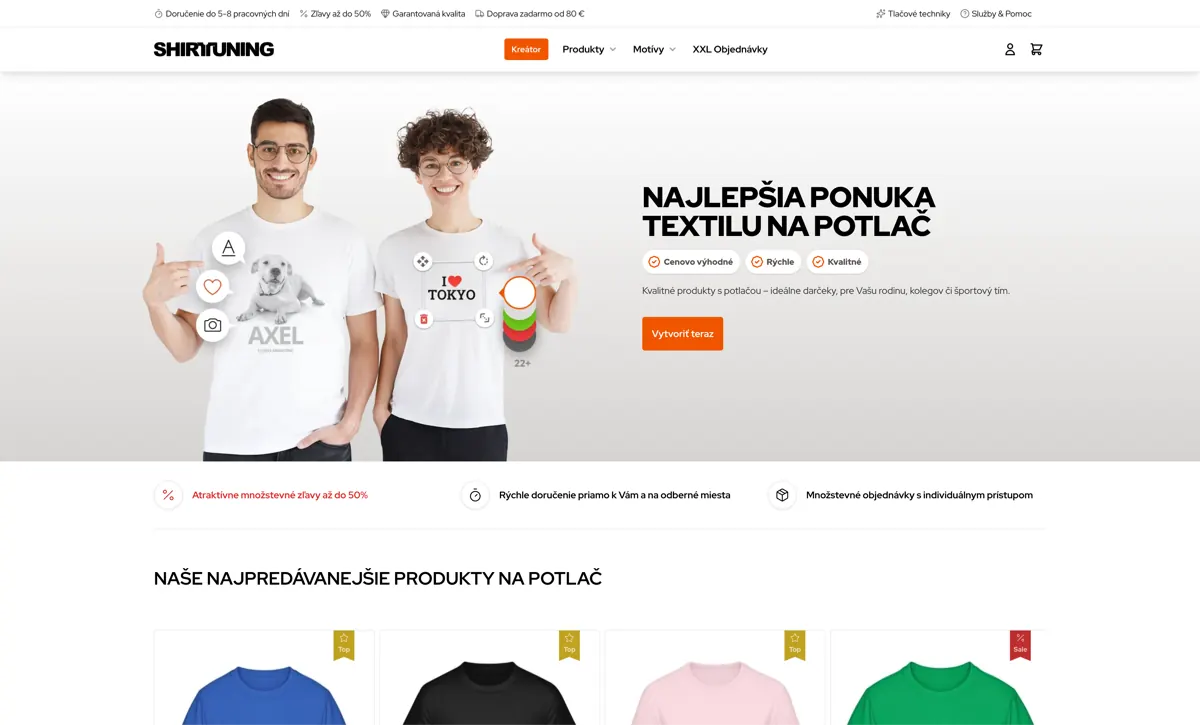
Each store has its own localized carriers (such as DHL/Deutsche Post for German orders) and free-shipping thresholds, while sharing one catalog of quality blanks from brands like Stanley/Stella and B&C Collection.
Their product customizer runs on ShirtPlatform, integrated via REST API directly into the product pages. The storefront itself is clean, lean, and fast in exactly the way a Hyvä-based build should be. Spending twenty minutes clicking through these stores with DevTools open is a better education in modern Magento architecture than most tutorials.
Sources & Fact Check Verification
- Magento Hyvä Theme Architecture: Verified that Hyvä replaces the legacy Luma stack (RequireJS, KnockoutJS, XML) with Tailwind CSS and Alpine.js to radically decrease JavaScript payloads. What is Hyvä theme?, On Tap
- ShirtPlatform Integration & Print Technologies: Verified that ShirtPlatform integrates with Magento natively and offers comprehensive POD technologies including DTG, DTF, Sublimation, and Flex/Flock. Shirtplatform by Brain Industries
- Tiered Pricing / Volume Discounts: Verified Shirt Tuning's active volume discount matrix (5% at 7 items, up to 50% for 150+ items). Alles rund um die Bestellung — Shirttuning
- Product Catalog Blanks: Verified the use of sustainable/premium blanks like Stanley/Stella and B&C Collection in the Shirt Tuning catalog. Preise & Qualität — Shirttuning
- Currency & Localization: Verified that the Czech Republic storefront (shirttuning.cz) natively processes prices in Czech Koruna (CZK).