Prices, scores and docs checked on 24 September 2026.
Anthropic released Claude Opus 5.5 on 22 September 2026, and the headline claim is bold. Anthropic says it "performs at the level of Claude Fable 5.1 on most work and costs 40% less to run than Opus 5."
Comparison posts showed up within hours. Some were useful. At least one said Opus 5.5 couldn't be verified yet. So before writing this, we went back to Anthropic's own announcement, pricing page and migration docs, looked at the first independent test results, and checked every number.
Here's what's true, what's still only a claim, and what we'd do if we were running a dev team today.
The short answer
- Make Opus 5.5 your default for coding, agents and everyday knowledge work. Anthropic's docs now say: "If you're unsure which model to use, start with Claude Opus 5.5 for most workloads."
- Keep Fable 5.1 for the jobs where it has already proven itself. Anthropic still recommends Fable "for demanding reasoning and long-horizon agentic work, or when your evals on Claude Opus 5.5 at higher effort still fall short."
- Plan to leave Opus 5, but there's no rush. It's now marked "Legacy" in Anthropic's docs, Opus 5.5 is cheaper on every line of the price sheet, and Anthropic says Opus 5 won't be retired before 24 July 2027.
- Watch the effort setting. The cheap default (medium) and the top benchmark scores (max effort) are not the same thing. More on this below.
- Set aside time for migration. The API has breaking changes. Changing the model name alone can break things.
Which model for which job
If you only read one table, make it this one. It's our recommendation, based on Anthropic's guidance and the independent results further down.
| The job | Start with | Effort |
|---|---|---|
| Everyday coding, code review, reports | Opus 5.5 | Medium (the default) |
| Hard bugs, multi-file refactors, tricky integrations | Opus 5.5 | High, then xhigh |
| Long-running autonomous agents, the hardest reasoning | Fable 5.1, after testing Opus 5.5 at high | High or above |
| Existing Opus 5 traffic | Move to Opus 5.5 once the API changes are fixed | Set it explicitly |
| High-volume, simple jobs (tagging, classification) | Wait for Sonnet 5.5 or Haiku 5.5 | Low |
The three models side by side
| Opus 5.5 | Opus 5 | Fable 5.1 | |
|---|---|---|---|
| Released | 2026-09-22 | 2026-07-24 | 2026-09-01 |
| Input (per 1M tokens) | $4 | $5 | $10 |
| Output (per 1M tokens) | $20 | $25 | $50 |
| Cache reads (per 1M tokens) | $0.20 | $0.50 | $0.25 |
| Context window | 1M | 1M | 1M |
| Max output | 128K | 128K | 128K |
| Default effort | medium | high | high |
Compared with Opus 5, Opus 5.5's input and output prices are 20% lower and cache reads are 60% lower. Compared with Fable 5.1, input and output are 60% lower. Put the other way, Fable costs 2.5 times as much.
What "40% cheaper" actually means
The list price cut is only 20%. Anthropic says the rest comes from efficiency: Opus 5.5 "costs less per token than Opus 5 and uses fewer tokens per task, which nets out to a 40% drop in costs."
One detail matters here. Anthropic measured that 40% "at default settings." For Opus 5.5, the default is medium effort. Opus 5's default was high. If you run Opus 5.5 at high or max effort, expect to save less.
To make the prices concrete, we took the example task from Anthropic's cost explainer and priced it on each model. The task runs 40 turns, with about 2.8 million input tokens (90% read from cache) and 60,000 output tokens.
| Model | Input cost | Output cost | Total |
|---|---|---|---|
| Opus 5.5 | $1.62 | $1.20 | $2.82 |
| Opus 5 | $2.66 | $1.50 | $4.16 |
| Fable 5.1 | $3.43 | $3.00 | $6.43 |
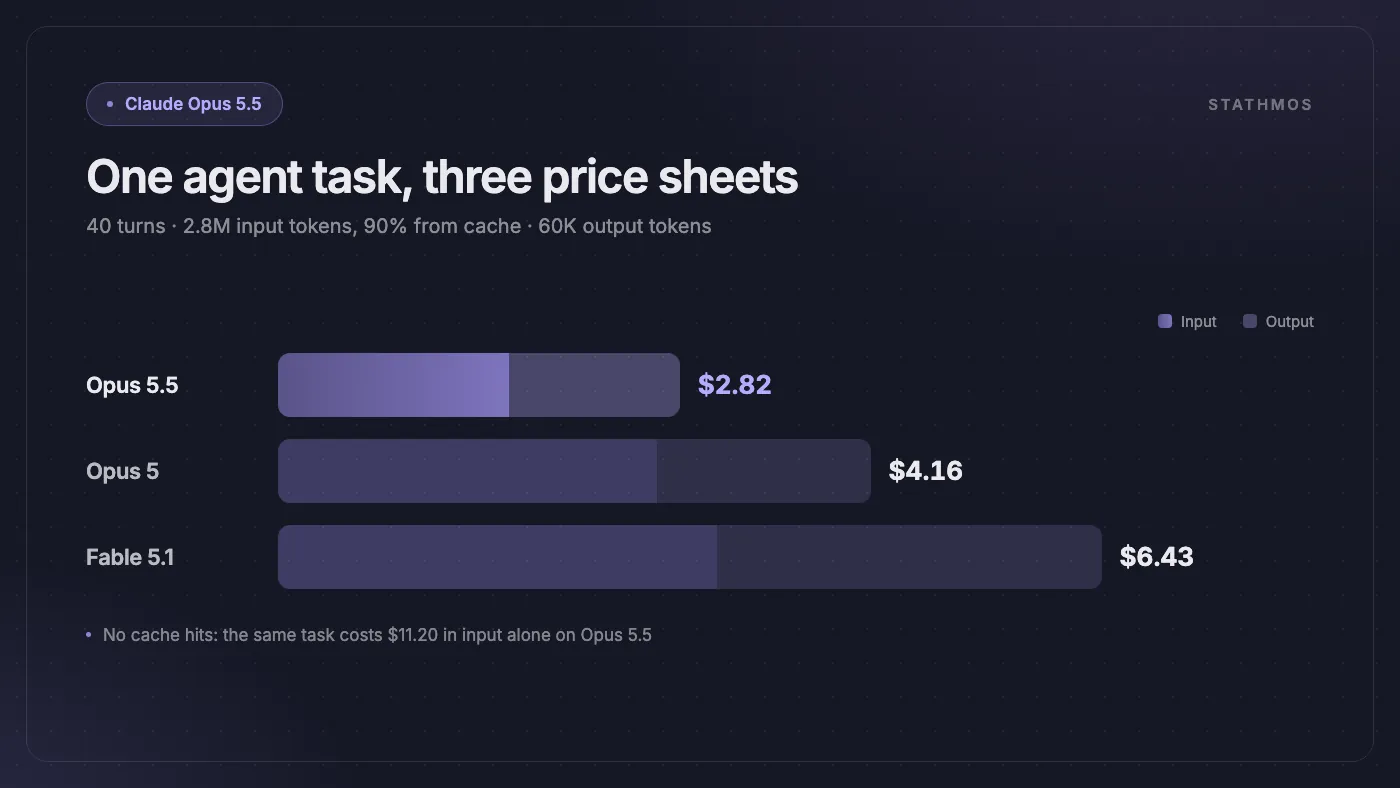
Two caveats. Like Anthropic's own example, the table leaves out cache-write costs. It also assumes every model uses the same number of tokens, which won't happen in real use. Treat it as a rough guide, not a quote.
Caching matters even more than which model you pick. The same task with no cache hits costs $11.20 in input alone on Opus 5.5, four times the whole task with caching. If your AI bill feels high, check your cache hit rate before you change models. We cover the rest of the cost picture in what AI really costs an e-commerce business.
How it scores on Anthropic's benchmarks
These are Anthropic's published numbers:
| Benchmark | Opus 5.5 | Fable 5.1 | Opus 5 |
|---|---|---|---|
| Agentic coding: Terminal-Bench 4.0 | 66.4% | 55.8% | 52.3% |
| Agentic coding: FrontierCode v1.1 | 54.4% | 50.3% | 48.0% |
| Agentic coding: CursorBench 4.0 | 57.8% | 51.8% | 46.6% |
| Knowledge work: GDPval-AA v2.1 (Elo) | 1846 | 1735 | 1708 |
| Computer use: OSWorld 2.0 (partial) | 81.8% | 80.7% | 74.0% |
| Reasoning: Humanity's Last Exam (with tools) | 67.7% | 65.6% | 63.6% |
Opus 5.5 leads on every row here. Four things to keep in mind:
- These scores use the highest effort settings. Anthropic ran Opus 5.5 at max effort for most of them and at xhigh for Terminal-Bench 4.0. That's not the medium default most teams will run. To be fair, Anthropic also says that at medium effort Opus 5.5 scored 54.6% on FrontierCode, higher than all other models.
- Anthropic plays down its own margins. It says benchmark gaps "have become a less reliable guide to real-world differences." It also says that in its own use, "the gap between Opus 5.5 and Claude Fable 5.1 is narrower than these scores suggest."
- It doesn't win everywhere. On Anthropic's own chart, OpenAI's GPT-6 Astra scores higher on AutomationBench (41.4% vs 40.0%) and Terminal-Bench-Science (64.6% vs 58.7%).
- It's hard to test. Anthropic's announcement says: "We see signs that Opus 5.5 often suspects it is being evaluated." That's one more reason to test it on your own real work.
What independent testing shows
Artificial Analysis, an independent benchmarking firm, has already tested Opus 5.5 on its Intelligence Index. Here's what it reports at the time of writing:
| Model and effort setting | Intelligence Index | Cost per task |
|---|---|---|
| Opus 5.5 (max) | 58 | $5.98 |
| Opus 5.5 (xhigh) | 56 | |
| Opus 5.5 (high) | 54 | |
| Fable 5.1 (max) | 53 | $7.63 |
| Opus 5.5 (medium, the default) | 51 | $1.34 |
| Opus 5 (max) | 51 | $5.86 |
Cost per task is Artificial Analysis's weighted average per Intelligence Index task; blank where it isn't published for that setting.
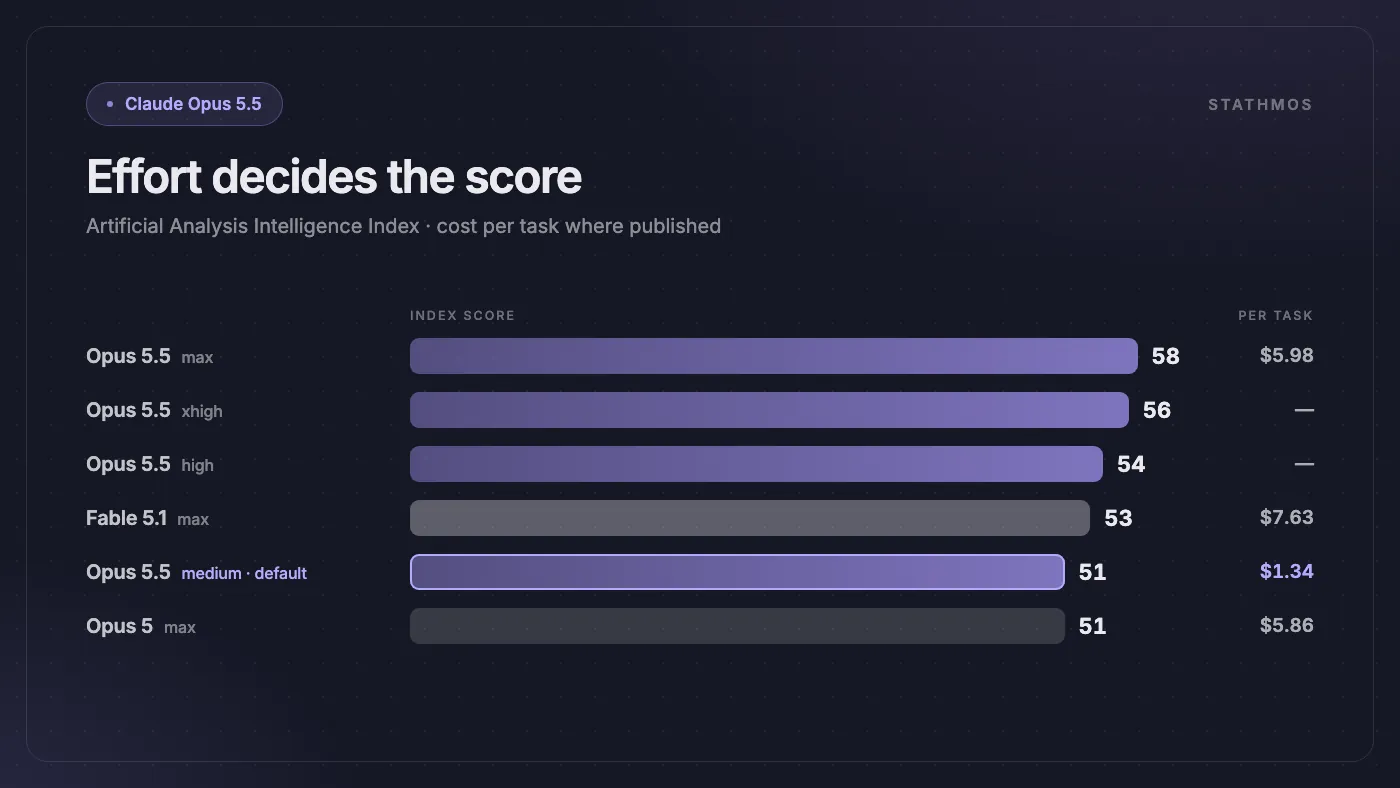
At max effort, Opus 5.5 takes the top spot on the index, and it cost less to run there than Fable 5.1: $5.98 per task, against $7.63 for Fable.
The more useful finding is lower down. At the default medium setting, Opus 5.5 scored 51. That matches Opus 5 at max effort, but it's below Fable 5.1. It only passed Fable at high effort or above. Medium is much cheaper, at $1.34 per task, and for plenty of everyday work it will be enough. But if you want Fable-level results on hard problems, plan to turn the effort up and pay for it.
What it looks like on real work
The most useful example Anthropic shared is an internal test. It asked Opus 5.5 and Fable 5.1 to rewrite HAProxy, a widely used load balancer, from C into Rust. Both rewrites passed nearly all of HAProxy's own regression tests. Opus 5.5 finished in 9.5 hours, compared with 12 for Fable 5.1, and cost 51% less. That's one task, run by Anthropic, but it's a real engineering job and not a puzzle.
Anthropic also published early customer feedback. GitHub said that in VS Code, Opus 5.5 "solved more terminal tasks than Opus 5 in less than half the steps." Optiver said that on its agentic coding tasks, it "matched Opus 5's quality in about half the turns, time and output tokens, cutting the cost of that workload by 40 to 50%." Read these as early reports, not audits.
Two other changes stand out:
- Speed. Anthropic says Opus 5.5 "generates output more than 30% faster than Opus 5." There's also a fast mode, still a research preview, that promises up to 2.5 times the speed at $8 input and $40 output per million tokens. It works in Claude Code and on the Claude API, but not on AWS, Google Cloud or Microsoft Foundry.
- Writing. Anthropic says the model "puts the most important information up front" and is "less likely to use jargon." That helps with reports, handovers and anything client-facing.
Before you switch: the gotchas
This is the section most comparison posts skip. From Anthropic's migration guide:
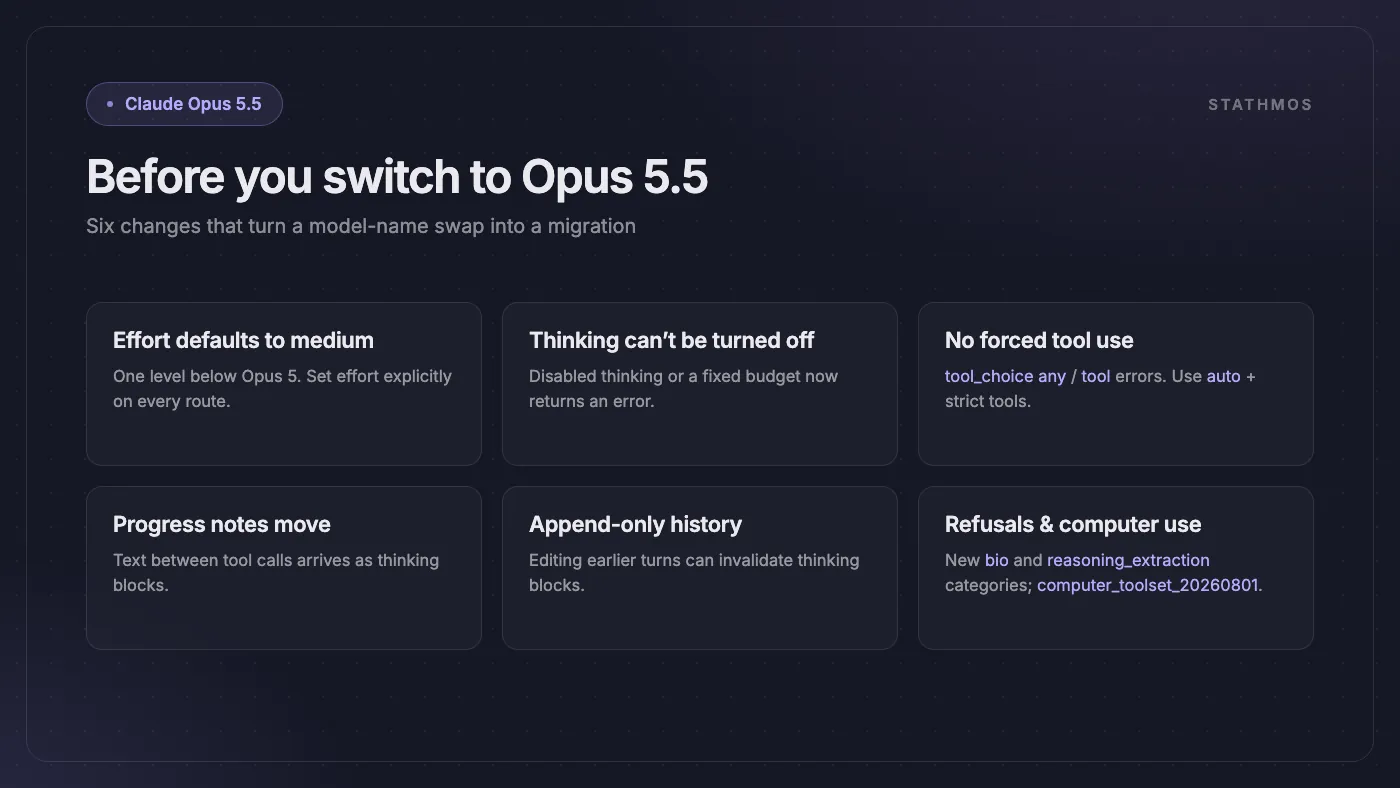
- Default effort is now medium, not high. If you never set effort, you'll get less thinking than you're used to. That's cheaper, but check quality on your hardest tasks and set effort explicitly.
- Thinking can't be turned off. Requests that disable thinking or set a fixed thinking budget now return an error. Use the
effortsetting (low to max) instead. - Forced tool use is gone.
tool_choiceset toanyor to a specific tool now returns an error. Useautowith strict tool use or structured outputs. - Your UI may go quiet. Short progress notes the model writes between tool calls now arrive as thinking blocks, not text. If you show those notes to users, they'll disappear unless you change the display setting.
- Leave room in
max_tokens. Thinking runs on every request, andmax_tokenscovers the thinking plus the answer. At xhigh or max effort, Anthropic suggests starting at 64K. - Keep conversations append-only. Editing the system prompt, tools or earlier messages mid-conversation can make thinking blocks invalid. On accounts created on or after 31 August 2026, that returns an error by default.
- More refusal categories. Your code should handle
stop_reason: "refusal", including new categories such asbioandreasoning_extraction. - Computer use has a new tool. On the Claude API and Google Cloud, the old computer-use tool is replaced by
computer_toolset_20260801. On Amazon Bedrock, the old tool still works.
None of this is hard, but it's a real migration, not a find-and-replace.
What we're still careful about
- Default settings vs top scores. The launch chart shows max effort. Your bill will likely reflect medium. Know which one you're getting.
- Fable 5.1 still has a place. Anthropic still recommends it for the hardest long-running agent work. Don't drop it without testing.
- Savings depend on your setup. Poor caching can cost you more than choosing the wrong model.
- Smaller models are coming. Anthropic says Sonnet 5.5 and Haiku 5.5 will follow "in the coming weeks." For high-volume, simpler jobs, it may be worth waiting for them.
How we'd roll it out
- Pick 10 to 20 real tasks from your backlog: a bug fix, a code review, a plugin upgrade, a data-import script, a report. For e-commerce teams, good tests are jobs you already know well, like a checkout bug or a product-catalogue import.
- Run them on your current model and on Opus 5.5 at medium effort. Compare quality, time and cost per task.
- If quality slips, try high effort before going back to Fable. That's also what Anthropic's own docs suggest.
- Fix the API changes above in a dev environment first. Anthropic's guide says to "test in a development environment before switching production traffic."
- Switch your default traffic and keep Fable 5.1 as a fallback for the hardest jobs.
Measure cost per finished task, not cost per request. A cheaper request that needs more turns to get the job done isn't cheaper. That is the same lesson we saw when we worked out the real ROI of agentic web development: the model is rarely the bottleneck, the way you test and review its work is.
The bottom line
For most teams, Opus 5.5 looks like the new default. It has lower prices, faster output and strong scores, and an independent test puts it at the top at max effort. Just don't assume the default setting gets you Fable-level results on your hardest problems. Test with your own tasks, pick the effort level that holds up, and let your numbers decide, not the launch chart.
Frequently asked questions
Is Claude Opus 5.5 better than Fable 5.1?
On Anthropic's benchmarks at max effort, yes, and Artificial Analysis also puts Opus 5.5 at max above Fable 5.1. At the default medium effort it scores below Fable 5.1, so for the hardest work you need high effort or above. Anthropic still recommends Fable 5.1 for demanding long-horizon agent work.
How much cheaper is Opus 5.5 than Opus 5 and Fable 5.1?
Opus 5.5 costs $4 input and $20 output per million tokens: 20% below Opus 5 and 60% below Fable 5.1. Cache reads are $0.20, against $0.50 on Opus 5. Anthropic's 40% saving against Opus 5 also counts fewer tokens per task and was measured at default settings.
What is the default effort on Opus 5.5?
Medium, one level below the high default on Opus 5 and Fable 5.1. Set effort explicitly, and raise it to high or xhigh for hard coding and agent work.
Can I just change the model name to switch to Opus 5.5?
Not safely. Thinking can't be turned off, forced tool use returns an error, progress notes move into thinking blocks, conversations must be append-only, and computer use needs a new tool on the Claude API and Google Cloud. Fix these in a dev environment first.
Should I stop using Opus 5?
Plan to move, but there's no rush. Opus 5 is marked Legacy and Anthropic says it won't be retired before 24 July 2027. Since Opus 5.5 is cheaper on every line of the price sheet, most teams should switch once the API changes are handled.
Sources
- Anthropic: Introducing Claude Opus 5.5
- Anthropic: Introducing Claude Fable 5.1 and Claude Mythos 5.1
- Claude Docs: Models overview
- Claude Docs: Pricing
- Claude Docs: Claude Opus 5 (legacy)
- Claude Docs: What's new in Claude Opus 5.5
- Claude Docs: Migrating to Claude Opus 5.5
- Claude Blog: What a task costs on Opus 5.5
- Artificial Analysis: Claude Opus 5.5 results
- Artificial Analysis: Claude Fable 5.1
- Artificial Analysis: Claude Opus 5
- TechCrunch: Anthropic releases Opus 5.5
Planning a Move to Opus 5.5?
We build and run AI and ML systems for commerce teams, and we can run the side-by-side test above on your own tasks: your backlog, your prompts, your cost per finished task. If you want help with the migration or the test, talk to us.